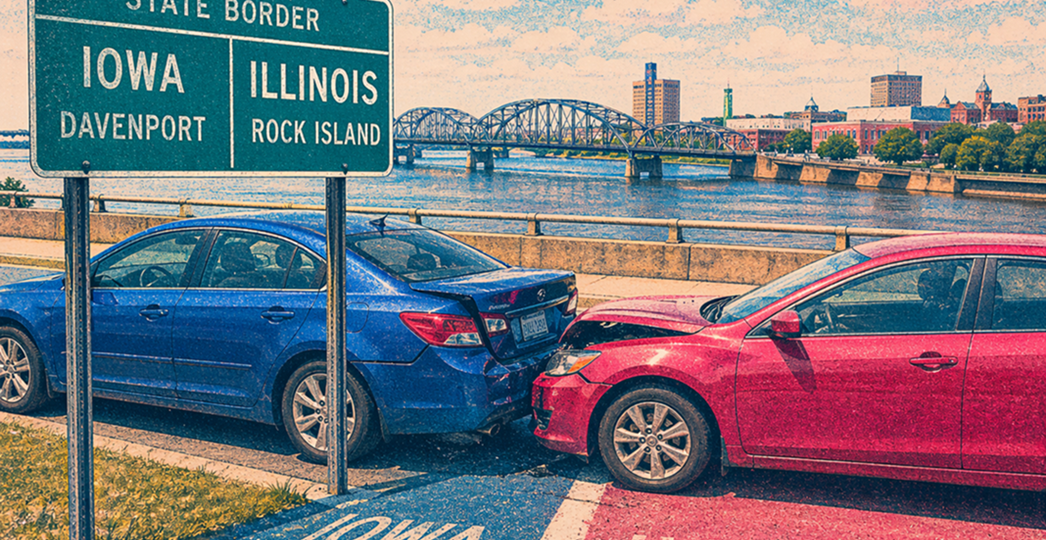
Bi-state car crashes are uniquely complicated in the Quad Cities, which happens to be one of the few metro areas in the country where simply crossing a bridge can drop you into an entirely different legal jurisdiction. Whether you are traveling between Davenport and Moline, Bettendorf and Rock Island, or anywhere else across the Mississippi River, you shift from Iowa law to Illinois law in a matter of seconds.
When one of those border crossings becomes the scene of a collision, the legal complexity begins immediately, because these claims are simply not handled the same way as an accident that occurs entirely within one state.
The Quad Cities injury attorneys at Winstein, Kavensky & Cunningham give you the key points that you need to know about navigating the jurisdictional maze of an Iowa-Illinois injury claim.
Iowa vs. Illinois: Key Legal Differences after a Bi-State Car Crash
Iowa and Illinois look similar on paper. Both use a modified comparative fault system, and both set a two-year deadline for filing a personal injury lawsuit. However, the legal differences in how cases are handled between the two states can significantly affect what compensation you recover after bi-state car crashes in the Quad Cities region.
Fault Standards and Comparative Negligence
In Iowa, Iowa Code § 668.3 governs the modified comparative fault analysis. The law in Iowa means you can recover damages as long as your share of fault remains below 50%. If a jury finds you 30% at fault, your recovery is reduced by 30%. Cross the 50% threshold, and you recover nothing.
Illinois law follows a nearly identical framework under 735 ILCS 5/2-1116. The threshold for fault is the same, but Illinois courts and insurance adjusters evaluate fault disputes differently. Different counties may also have their own procedural rules.
A seasoned Quad Cities-area personal injury law firm, like Winstein, Kavensky & Cunningham, will have attorneys and support staff who can represent clients in both Iowa and Illinois courtrooms.
Regional Factors That Can Impact a Bi-State Car Crash
Your lawyer is also going to have to dig into a few other regional challenges that can seriously impact your case.
Insurance Rules
Illinois and Iowa handle insurance completely differently. If you are in Illinois, the state mandates minimum bodily injury or death coverage for personal injury liability, as well as uninsured motorist (UM) and underinsured motorist (UIM) bodily injury coverage.
Cross the river into Iowa, and you’re dealing with their Financial Responsibility Law. Meaning that drivers essentially just have to prove they have the financial means to cover the damage, which drastically changes how the actual insurance policies are structured and enforced.
Location Dictates Everything
When it comes to actually filing your claim, geography is also a deciding factor. It literally comes down to exactly where the bumpers met.
If your crash happened on the Iowa side of the I-74 bridge, you are fighting an Iowa legal battle. If the impact happened just a bit further down on the Moline approach, you’re suddenly navigating an Illinois claim.
Where Bi-State Car Crashes Mostly Happen in the Quad Cities
If you live and drive in the Quad Cities, crossing the Mississippi River is just part of your daily routine. But when a crash happens on or near one of these state-line crossings, a standard accident suddenly turns into a complicated legal headache.
The most complex bi-state claims we see almost always happen in these notorious corridors:
- The I-74 Bridge: Connecting Bettendorf to Moline, this stretch has been a hotspot for decades. Whether it’s a sudden multi-vehicle pileup, a chain-reaction rear-ender, or inclement weather chaos, this bridge sees it all.
- The Fred Schwengel Memorial Bridge: Linking LeClaire to Rapids City, this route carries a heavy volume of large freight. Because of the volume, crashes here regularly involve commercial trucks and semi-trailers.
- The Centennial Bridge: Handling the daily commuter grind between downtown Davenport and Rock Island, this crossing has a long, consistent history of collisions in both directions.
The danger doesn’t stop at the water’s edge, either. A large number of bi-state claims originate right before you even cross the river. We frequently see accidents on the I-74 approach ramps in Bettendorf, on the busy highway corridors in Rock Island and Moline, and on the surface streets feeding into all the bridges in the Quad Cities.
Common Injuries from Bi-State Car Crashes
When traffic suddenly bottlenecks on these ramps or bridge decks, the result is usually a harsh rear-end collision. Because of this, soft tissue damage and severe whiplash are easily the most common injuries reported in the area.
On the more severe end of the spectrum, the high-speed bridge and interchange crashes are also a frequent cause of life-altering traumatic brain injuries (TBIs).
If you’ve been hurt at any of these local bottlenecks, your very first call shouldn’t be to just any lawyer. You need a Quad Cities car accident attorney from Winstein, Kavensky & Cunningham who actively handles bi-state claims and knows exactly how to navigate the legal systems in both Iowa and Illinois. You also need to know that they will be with you from start to finish, no matter if your case goes to court or not.
Iowa vs. Illinois Fault Rules Car Accident FAQ
Yes, significantly. For bi-state car crashes, the state where the accident occurred generally controls which laws apply to your claim, including fault rules and insurance requirements. A one-lane difference can change everything about which state’s law governs your claim.
In most cases, you file in the state where the crash occurred. There are exceptions depending on where the at-fault driver resides and which court has proper jurisdiction. A Winstein, Kavensky, and Cunningham car accident attorney will analyze those factors before filing anything on your behalf.
This is more common than you might expect, especially on the I-74 and I-80 bridges. Physical evidence, GPS data, police reports, and crash scene documentation can establish the precise location of impact. Your Quad Cities car accident lawyer will evaluate law enforcement records to confirm jurisdiction before proceeding.
Yes, if they are licensed to practice in both states. Winstein, Kavensky & Cunningham represents injured clients across the full Quad Cities bi-state area in both Iowa and Illinois, which is exactly why clients involved in bi-state car crashes consistently turn to our firm.
Call Top Quad Cities Injury Lawyers after a Bi-State Accident
Bi-state car crashes are not cases to navigate alone or with a single-state attorney. The legal complexity of an Iowa-Illinois accident—from comparative fault determinations to court filings to insurance coverage disputes—requires a Quad Cities car accident attorney who knows both systems from the inside.
Winstein, Kavensky & Cunningham has represented injured clients across Davenport, Bettendorf, Moline, and Rock Island for decades. Licensed in both Iowa and Illinois, our attorneys handle the full scope of bi-state personal injury claims—from rear-end collisions and soft tissue injuries to serious whiplash and traumatic brain injury cases resulting from crashes on the I-74 bridge, the Centennial Bridge, and every corridor connecting our two-state community.
After a bi-state accident, time matters. Call Winstein, Kavensky & Cunningham to schedule your free consultation with experienced personal injury lawyers serving the entire Quad Cities, as well as surrounding cities in both Illinois and Iowa.
The information on this blog is for general information purposes only. Nothing herein should be taken as legal advice for any individual case or situation. This information is not intended to create, and receipt or viewing does not constitute an attorney-client relationship.