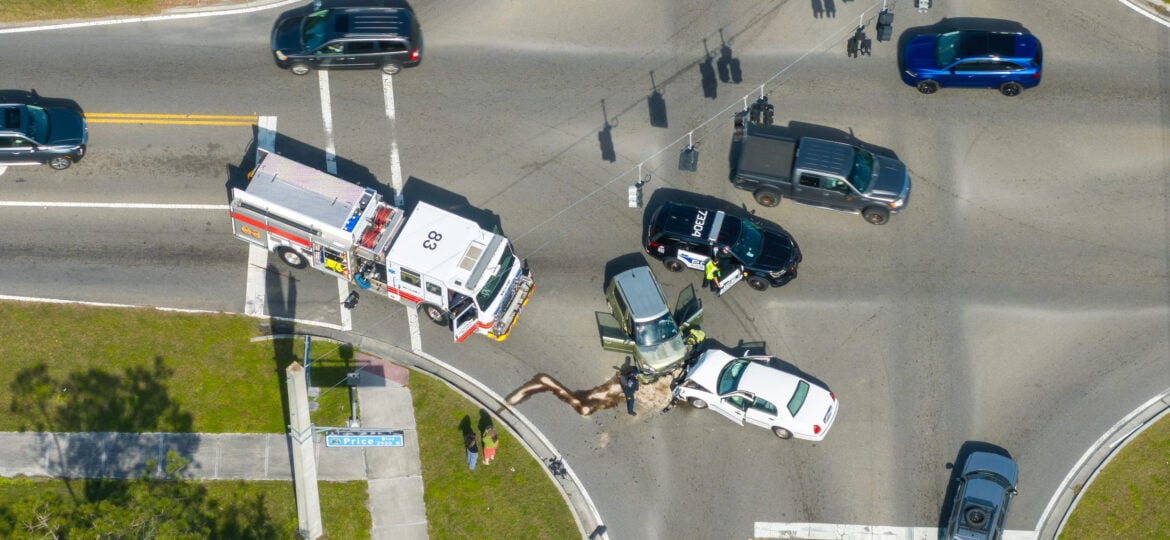
You’re heading east on the I-74 bridge when a driver drifts into your lane and clips your car. A week later, their insurance adjuster calls. They say that even though their driver may have caused the crash, you are also partially at fault because you were driving 8mph over the posted speed limit. They then try to reduce the amount of compensation you can recover by 30%. That’s comparative negligence at work.
If you were hurt in a Quad Cities area car accident, truck wreck, work-related accident, or other type of incident and the other side is already pointing fingers and trying to reduce what you can recover, read this before you talk to the adjuster again.
How Comparative Negligence Works in Iowa and Illinois
Comparative negligence determines how responsibility is divided among all parties that may have contributed to an accident, affecting their ability to recover compensation.
For example, if you’re found 20% at fault for an accident that caused $100,000 in damages, your potential recovery would be reduced to $80,000.
Iowa and Illinois both follow modified comparative negligence rules. Injured people can recover damages when their share of fault is 50% or less, but their compensation is reduced based on their responsibility for the incident.
Illinois Modified Comparative Negligence
Under 735 ILCS 5/2-1116, Illinois applies comparative negligence to claims involving bodily injury, death, property damage, and certain product liability cases. Illinois law also makes an exception for personal injury claims based on childhood sexual abuse, where fault cannot be assigned to the plaintiff.
Iowa Comparative Fault
Under Iowa Code section 668.3, you may still have a claim if you share responsibility for an accident. For example, if you’re injured in a collision at Locust Street and Division Street in Davenport and found 40% at fault, your compensation would be reduced by 40%. You cannot recover damages if your share of the fault exceeds the combined fault of the defendants and other qualifying parties.
Which State’s Rule Applies in the Quad Cities?
Generally, the law of the state where the collision occurred will apply to the injury claim. However, that isn’t always the final answer.
A crash involving an Iowa driver in Rock Island, Illinois, will generally be governed by Illinois law. However, the drivers’ residences and other connections to each state could affect which laws govern specific issues. An insurance policy may also raise separate questions about available coverage.
Whether the incident happened in Illinois or Iowa, our attorneys are licensed in both states, allowing us to represent clients with injury claims in either state.
How Insurers Use Comparative Negligence
Insurance adjusters handling injury claims in the Quad Cities, including accidents in Rock Island, Moline, and Davenport, may look for reasons to question your account or reduce what they pay.
Some tactics they may try to use during the claims process include:
- Recorded statements: Saying you glanced at your mirror before impact could prompt questions about whether you saw the other vehicle in time.
- Questions about speed: An adjuster may ask whether you were speeding, even if there is little evidence that your speed contributed to the collision.
- Treatment delays: If you wait two weeks to see a doctor, the insurer may question whether the crash caused your injuries.
- Social media activity: Photos of you at a backyard cookout could lead an adjuster to question your reported back pain or physical limitations.
- Apologies at the scene: Saying “I’m sorry” out of concern for someone else doesn’t automatically mean you caused the crash, but an insurer may bring it up when discussing fault.
Does Comparative Negligence Apply to Workers’ Comp?
Generally, no. Workers’ compensation in Iowa and Illinois is a no-fault system, so your own mistake usually won’t reduce your benefits if you get hurt on the job. However, certain circumstances, including intoxication that meets the state’s legal requirements, can affect whether you qualify for benefits.
Fault becomes important when someone other than your employer causes your injury. If another driver rear-ends your truck while you’re making deliveries, you may have a workers’ compensation claim and a separate personal injury claim against that driver. Comparative negligence would then apply to the injury claim, meaning your share of the blame could reduce the compensation you recover from the driver.
Our post on cold weather injuries at work explains when an injury may qualify for workers’ compensation.
Contact Us for Help
How to Protect Your Claim from a Fault Argument
Evidence can become harder to collect as time passes. If you can do so safely, take photos of the damage and surrounding area before anything changes. A few other steps can help protect your claim:
- Get names and phone numbers from witnesses before they leave.
- Write down the police report number.
- See a doctor within a day or two, even if you feel okay.
- Avoid giving a recorded statement until you’ve talked with a lawyer.
- Keep details about the accident off social media.
Already hearing from an adjuster that you share the blame? Request a free consultation before you agree to any percentage.
Comparative Negligence FAQs
Yes. Crossing mid-block, riding against traffic, or riding without lights at night can all be considered when determining fault. A pedestrian struck while crossing near downtown Davenport or a bicyclist hit along a busy Moline street could share some responsibility for the crash. However, a driver’s speeding or distracted driving may still account for most of the fault.
Courts consider a child’s age, experience, and ability to recognize danger rather than automatically holding them to adult standards. Very young children may not be capable of negligence under the circumstances. If a driver hits a child crossing near a school or neighborhood park in Rock Island or Bettendorf, the child’s age and understanding of traffic safety may matter when determining fault. An insurance company cannot simply assume the child was responsible for the accident.
A property owner in Muscatine, Davenport, or Rock Island may argue that you should have noticed a hazard or taken steps to avoid it. For instance, an owner might claim you should have seen a wet floor or icy walkway and avoided a slip-and-fall injury. Evidence showing the condition of the walking surface, how visible the hazard was, and whether the owner knew about it can help challenge that argument.
It can. A spouse’s claim for lost companionship and support, called loss of consortium, is tied to the injured person’s case. In Iowa, the comparative fault statute bars that claim when the injured spouse’s fault crosses the same line that would bar their own case.
Arguing over percentages doesn’t stop the clock. Most injury lawsuits must be filed within two years in both Illinois and Iowa. Claims against a city, county, or other government body can come with much shorter deadlines.
Call a Quad Cities Personal Injury Lawyer
An adjuster’s fault percentage is an opening number, not a final ruling. Before you accept it, get a second look from someone on your side.
The attorneys at Winstein, Kavensky & Cunningham have more than 120 years of combined experience helping injured people across the Quad Cities. We serve clients in Rock Island, Henry, Mercer, Whiteside, and Knox counties in Illinois, and Scott, Clinton, Muscatine, Cedar, and Jackson counties in Iowa. Our team of skilled attorneys is also prepared to take your case to trial to help ensure you get the best outcome possible.
Call (309) 794-1515 or request a free consultation. Filing deadlines apply, so find out where you stand now.