Whether you are crossing the new I-74 bridge, merging onto I-80 near Walcott, or navigating the US-61 corridor through Rock Island County, you are sharing the road with 80,000-pound machines. In a collision between a 500-pound motorcycle and a fully loaded semi-truck, there is rarely a fair fight — and far too often, the reason a crash happens at all is that the truck driver simply never saw the rider. This is known as a no-zone motorcycle accident, and understanding it could also win your case.
What Is the No-Zone on a Semi Truck?
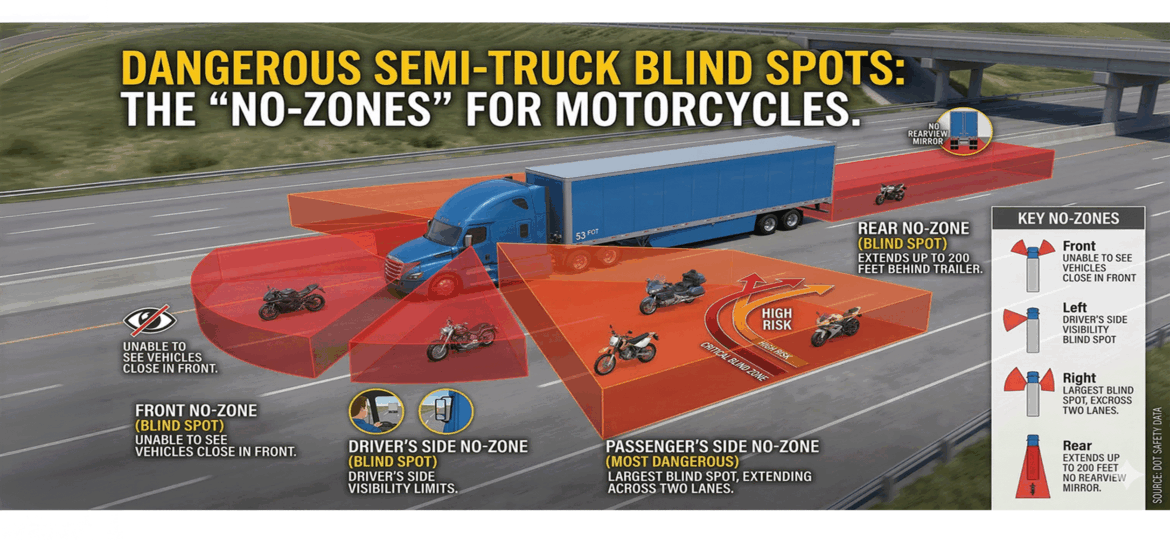
A semi-truck has four massive blind spots that the Federal Motor Carrier Safety Administration (FMCSA) officially calls the “No-Zone” — areas around the vehicle where a truck driver has little or zero visibility, even with properly adjusted mirrors.
- Front No-Zone: directly in front of the cab for up to 20 feet
- Rear No-Zone: directly behind the trailer for up to 200 feet
- Left-Side No-Zone: one lane wide along the driver’s side, extending roughly the length of the cab
- Right-Side No-Zone: two lanes wide along the passenger side, stretching nearly the full length of the trailer — the most dangerous zone for motorcycle riders
A car might be partially visible in a truck’s mirrors at the edge of one of these zones. A motorcycle, with its narrow profile, can be completely swallowed. Here is the rule every rider needs to know: if you cannot see the truck driver’s face in the truck’s side mirror, the truck driver cannot see you.
Related topic: Why Are Blind Spots a Problem for Passenger Vehicle Drivers?
Why Motorcycles Vanish — The ‘Ghost Rider’ Effect
Cars and SUVs have bulk. Even in a blind spot, a side mirror may catch a fender, a roofline, or a headlight. A motorcycle offers none of that. Its slim silhouette fits entirely inside the dead zone, making a rider effectively invisible to a driver who is legally required to check before changing lanes.
This effect is the main cause of no-zone motorcycle accidents: it’s not always the truck driver’s fault. Sometimes the rider is simply invisible — and the driver never knows it until after the impact.
“Whether you are crossing the new I-74 bridge or merging onto I-80 near Walcott, you are sharing the lane with 80,000-pound machines. In a battle between a 500 lb bike and an 18-wheeler, the No-Zone is a no-win scenario for riders.”
The ‘Drafting’ Danger: Why Lingering in the No-Zone Is Doubly Deadly
Being invisible is dangerous enough. But riding close to a large semi-truck creates a second physical hazard that most riders don’t anticipate: air turbulence.
At highway speeds, a large trailer generates a powerful vortex of displaced air trailing behind and alongside it. For a lightweight motorcycle, this draft can act like a magnet — pulling the bike toward the trailer, disrupting steering, and making it extremely difficult to move safely out of the blind spot. If you find yourself riding near a semi on I-280 or on the I-74 bridge approach, do not linger. Accelerate through or drop back. There is no safe middle ground.
How Far Back Should a Motorcycle Ride Behind a Semi?
The minimum safe following distance behind a semi-truck is 200 feet — roughly the length of the rear no-zone itself. In practice, most safety experts recommend maintaining at least four seconds of following distance at highway speeds, which gives you enough time to react if the truck brakes suddenly and keeps you outside the turbulence pocket.
On congested routes like US-61 through Moline or I-80 near LeClaire, maintaining that gap is harder. Traffic pressure, merging lanes, and on-ramps can quickly compress following distances. Stay conscious of it. The moment you ride into that rear no-zone, you become invisible to the driver above you.
How to Stay Visible to a Semi Truck Driver on a Motorcycle
You cannot control what a truck driver does. You can control how visible you are. These habits reduce your exposure in the no-zone:
- Use lane positioning strategically — ride in the portion of your lane that puts you in the truck driver’s mirror, not the center of a blind spot.
- Run your headlights at all times, even during the day. A beam of light is more visible than a dark bike silhouette.
- Apply the mirror rule religiously: if you cannot see the driver’s face, move.
- Never pass a semi on the right side. The right-side no-zone spans two lanes — it is the most dangerous position on the road for a motorcycle rider.
- When passing, do it decisively. Move through the blind spot at speed — don’t ride alongside a trailer at matching speed.
Truck Driver Tips to Spot Motorcycles in Blind Spots
This isn’t just a motorcycle problem. Commercial drivers share legal responsibility for the no-zone. Under FMCSA regulations, truck drivers have a heightened duty of care — they must check their mirrors regularly and signal before any lane change.
Training programs remind CDL drivers that a motorcycle can hide where a car cannot, and that extra mirror checks before lane changes are not optional — they are part of the duty of care built into a commercial license.
Suppose a truck driver fails to see a motorcycle because they didn’t check their mirrors; that failure is negligence — not an accident. The law does not accept “I didn’t see them” as a complete defense.
Related topic: Motorcycle Accident Statistics for IL and IA
Who Is at Fault if a Semi Hits a Motorcycle in the Blind Spot?
This is the question that determines whether an injured rider recovers compensation — or walks away with nothing. The answer depends on the facts, the state, and the evidence preserved in the aftermath.
In a no-zone motorcycle accident, fault often centers on whether the truck driver met their duty of care. Did they signal before the lane change? Did they check their mirrors? Did they adjust for known traffic conditions on a route like the I-74 corridor, where motorcycle traffic is common?
The Trucking Company’s “Failure to See” Defense
Trucking companies routinely argue that their driver simply “couldn’t see” the motorcycle — and that a driver cannot be negligent for failing to see what was invisible. This is a common defense, but it can be overcome.
An experienced attorney will subpoena the truck’s Electronic Control Module (ECM) — the vehicle’s black box — which records speed, braking events, and turn signal use in the seconds before a crash. If the data shows no signal activation and no braking before impact, the “I didn’t see them” defense falls apart.
Time is critical here. ECM data is routinely overwritten. The sooner an attorney sends a spoliation letter demanding preservation of evidence, the better your chances are of securing that data.
A Warning about Lane Filtering in Iowa and Illinois
Some riders may be tempted to filter between trucks to avoid getting stuck in a semi’s blind spot in slow traffic. In 2026, however, lane splitting and lane filtering remain illegal in both Iowa and Illinois. If you were filtering at the time of your crash, a defense attorney could argue that your own behavior contributed to the accident.
Illinois Motorcycle Accident Semi Truck Statute of Limitations
If your no-zone motorcycle accident happened on the Illinois side of the Quad Cities — in Rock Island, Moline, East Moline, or anywhere in Rock Island County — per 735 ILCS 5/13-202, you have two years from the date of the accident to file a personal injury claim.
Miss that deadline, and no attorney, no matter how strong your case, can help you recover compensation. Illinois courts enforce this deadline strictly.
Two years sounds like a long time. It isn’t. Evidence disappears. Witnesses move. ECM data gets overwritten. The earlier you speak with an attorney, the more tools they have to build your case.
Iowa Semi Truck Accident Motorcycle Two-Year Deadline
Iowa Code 614.1(2) imposes the same two-year statute of limitations for personal injury claims. If your crash occurred in Scott County — in Davenport, Bettendorf, or anywhere along the Iowa-side corridors — your clock starts running on the date of the accident.
Iowa also applies comparative fault rules (Iowa Code 668.3). If the defense can show you were partly responsible — riding in a blind spot for an extended time, making an illegal lane change, or riding without proper lighting — your award may be reduced proportionally. If you’re found more than 51% at fault, you recover nothing. An attorney who understands Iowa’s trucking litigation landscape can make the difference between a full recovery and zero.
Injured in a No-Zone Motorcycle Accident in the Quad Cities?
If you or someone you love was hurt in a no-zone motorcycle accident — on the I-74 bridge, on I-80 near LeClaire, on US-61, or anywhere else in Scott County, Iowa, or Rock Island County, Illinois — you need a Quad Cities motorcycle accident attorney who knows how trucking companies fight these cases and how to beat them.
At Winstein, Kavensky & Cunningham, we represent motorcycle riders across Davenport, Bettendorf, Rock Island, Moline, and East Moline in both Iowa and Illinois courts. We know how to pull ECM data, challenge the “failure to see” defense, and fight for full compensation under both Iowa and Illinois law. We also don’t shy away from going to court on challenging injury claims. The consultation is free. The advice is real. And the clock is already running. Don’t wait!
Call (309) 794-1515, use LiveChat, or fill out our secure online form to schedule a free consultation.
The information on this blog is for general information purposes only. Nothing herein should be taken as legal advice for any individual case or situation. This information is not intended to create, and receipt or viewing does not constitute an attorney-client relationship.